
Trade that Works
Faster, Frictionless, Fairer, and Further Trade
Progress So Far
TradeMark Africa works with governments and businesses to cut the time and cost of moving goods across African borders – from the software that clears a consignment to the port that ships it.
9 million
hours removed from trade processes across East Africa each year
Digital trade systems have cut the time businesses spend on trade formalities by two-thirds – from 97 hours in 2017 to 31 hours in 2023, representing a 68% reduction according to an independent evaluation.
Across the businesses surveyed, this amounts to some 9 million hours a year, with micro and small firms gaining most.
TradeMark Africa contributed to these results by digitising and connecting the systems that ports, borders and regulatory agencies use to process trade, working with African governments and with financing from the EU, the UK, Ireland, the Netherlands and Norway.
50% less
Trade applications cost half what they did
Completing a trade application in 2023 cost businesses $14, down from $27 in 2017, reducing business costs by 49%.
The savings amounted to some $2 million a year across the firms surveyed.
With backing from the EU, the UK, Ireland, the Netherlands and Norway, TradeMark Africa worked with governments across Eastern Africa to digitise and integrate trade systems and services across ports, borders and regulatory agencies.
83% faster
Border crossings at selected one-stop border posts
Crossing the border at Elegu now takes 83% less time than before; at Goli-Mahagi, 58% less, with customs processing times at Goli down 63%.
With funding from Finland, the Netherlands and the UK, TradeMark Africa worked with the governments of Uganda, the DRC and South Sudan to upgrade and operationalise the One-Stop Border Posts at Elegu, Goli and Mahagi, where, when fully operational, traders will complete formalities of both countries in a single stop/location.
Trade becomes frictionless when businesses can trade with confidence. Improvements in standards, quality infrastructure and sanitary and phytosanitary systems reduce trade barriers and make it easier for businesses to access new markets and grow exports.
Over 2,000
Standards harmonised across East Africa
Over 2,000 East African Community standards were aligned with international practice, so a product certified in one Partner State can be sold in all of them.
The time businesses wait for conformity assessment fell from an average of seven months in 2017 to four in 2023- a 44% reduction.
In the evaluation survey, more than 80% of firms said compliance had improved their prospects of selling in new markets.
With funding from the Netherlands and the UK, TMA worked with the East African Community, its Partner States and national standards bodies to simplify standards, improve testing and certification, and remove technical barriers to trade.
290%
Growth in commodity trade through Tanzania’s exchange
The value of commodities traded through the Tanzania Mercantile Exchange rose from $300 million (TZS 700 billion) in 2023-24 to $1.1 billion (TZS 2.8 trillion) in 2024-25.
About a 290% increase, led by sesame, pigeon peas, chickpeas, green grams, and cashew nuts through the digital marketplace.
TradeMark Africa contributed by automating and expanding the exchange’s digital trading platform and training farmers, traders and other market participants with funding from Ireland, Norway and the UK, and in partnership with the Tanzania Mercantile Exchange, and Tanzania’s market regulators.
Trade becomes fairer when everyone has the opportunity to participate, compete and benefit. By reducing barriers faced by women, young people, small-scale traders and persons with disabilities, TradeMark Africa and its partners create more inclusive trade systems that expand economic opportunities, increase incomes and strengthen participation in formal trade.
95,000
Traders get market prices and buyers through one free app
More than 95,000 traders in Uganda, Kenya, Burundi, Tanzania and Rwanda use iSOKO, a free platform that connects them to market information and buyers.
In the project’s user survey, over 80% of traders reported a 70% increase in annual sales.
Global Affairs Canada funded the development of iSOKO, and national chambers of commerce in each country host the platform
Sources:
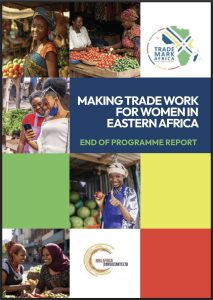
- (2025). Making Trade Work for Women in Eastern Africa (Project No. P-005606, reporting period: 29 March 2018-31 March 2025). Final Project Report.
- Kenya National Chamber of Commerce and Industry, Uganda Women Entrepreneurs Association Limited, Tanzania Women Chamber of Commerce, the Burundi Federal Chamber of Commerce and Industry, and the Rwanda Private Sector Federation
$32 million
in additional annual trade value for cross-border traders
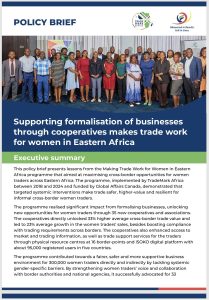
A Women in Trade Programme in Eastern Africa worked with 153,000 people, most of them women trading across borders.
By its close, participants reported a 23% increase in monthly sales (worth an estimated $32 million a year in additional trade by the final evaluation calculation).
The programme, funded by Global Affairs Canada, set up information centres at 16 border crossings and established 35 cooperatives, trained traders in organisational and financial management, conflict sensitivity, cross-border trade rules, and access to finance.
TMA implemented the programme with EASSI, Pro-Femmes/Twese Hamwe, AMSCO, Search for Common Ground, and the women traders’ own associations.
26,000
Young people accessed employment and enterprise opportunities
Over 26,000 young people in Rwanda secured employment or business opportunities through the Value-Added Initiative to Boost Employment, funded by the Mastercard Foundation.
Enterprises led by women and young people supported under the programme exported goods worth $9.5 million over a period of nearly three years (July 2023 to March 2026).
TradeMark Africa and its partners invest in the roads, ports and border posts that carry the region’s trade, cutting the distance, in time and cost, between East African producers and their markets at home and abroad.
Over 1 million
Truck-hours saved annually on Mombasa trade routes, Trucks Access Mombasa Port in Half the Time
Average travel times on the Magongo, Airport, Port Reitz and Kipevu roads serving the Port of Mombasa fell from 145 minutes in 2019 to 78 minutes in 2024.
Based on average daily traffic of 2,800 trucks, that is more than 1 million truck-hours saved each year.
With funding from the UK and Denmark, TradeMark Africa worked with the Government of Kenya, the County Government of Mombasa, the Kenya National Highways Authority and the Kenya Ports Authority to upgrade these roads.
More efficiently
Markets connectedalong the Lake Albert trade corridor
Customs clearance time at Uganda’s Ntoroko Lake Port once took nine hours; it now takes one.
The port handles trade across Lake Albert between Uganda and the DRC.
Financed by the UK and working with the Government of Uganda and border agencies, TradeMark Africa supported upgrades to the port’s customs and immigration facilities, warehousing, ICT and security systems.
Stories of Change
Tanzania Mercantile Exchange (TMX) Documentary
Rusizi II One Stop Border Post – Rwanda
Baraza la Biashara: Digital Trust in Trade-Infrastructure, Data and the Politics of Access
Mombasa West urban road upgrades
TradeMark Africa launch in Ghana
Toolkit
TradeMark Africa was established to reduce barriers to trade across Africa, to support economic growth and reduce poverty. Phase I ran from 2011 to 2017, Phase II from 2017 to 2023 and Phase III (2023 to 2030) is currently under implementation. As part of assessing progress under Phase II, TradeMark Africa commissioned independent evaluations of its programmes. All results presented reflect TradeMark Africa’s contribution, based on the independent portfolio and thematic evaluations. Outcomes were achieved in partnership with governments, regional institutions and the private sector.
Explore independent evaluation reports for 2011–2017: https://trademarkafrica.com/independent-evaluation-reports
Download 2017–2023 evaluation reports: https://trademarkafrica.com/strategic-evaluation/
Download the annual reports: https://trademarkafrica.com/annual-reports/